
Identify a Union County Owner
A reliable answer pairs two documents. The Union County Tax Assessor keeps owner names, mailing addresses, and values in each parcel file, which makes the tax roll the fastest source for the current owner of record. The Clerk's deed records then supply the recorded conveyance behind that entry. Start with the parcel.
- Search the physical address through the Union County Assessor route or GIS viewer and select the matching parcel.
- Copy the owner name, mailing address, map or parcel number, and any legal description shown on the parcel record.
- Search the owner as grantee in GSCCCA, then compare the latest conveyance with the parcel and legal description.
- If a company, trust, or estate appears, search the exact recorded name in the proper entity or probate source.
- For a purchase, dispute, or complex chain, take the documents to a title professional rather than treating the lookup as a title opinion.
This route answers the ownership question with official public records. It never assumes the person receiving the mail lives on the land. The address, parcel, and deed stay tied together throughout.
Union County Ownership Sources
No single Union County office holds every ownership fact. The tax roll exists for assessment, the deed index tracks recorded instruments, and the parcel map supplies location context. Use each source for its own role.
| Where ownership appears | What it provides | Currency and access |
|---|---|---|
| Tax Assessor parcel record | Owner name, mailing address, land and building evaluation | Most current published digest; county portal, phone, or counter |
| GSCCCA deed index | Grantee, grantor, instrument type, date, book and page | Recorded index; images may require account and payment |
| Clerk of Superior Court | Original recorded deed, plats, liens, and related instruments | Clerk record controls; counter and copy request |
| Union GIS Mapping Site | Mapped parcel and identifier | Reference geography; dynamic viewer |
The owner of record is whoever the relevant official record names, person or entity. That can differ from the occupant. A mailing address shows where tax bills and notices go, while a situs address identifies the land itself.
Union County Assessor Names Owners
The Union County Tax Assessor page states that parcel records hold owner names and addresses. The office publishes no detailed guide to its online property card, so exact field labels, wildcard rules, and update timing are not spelled out. Try name variants when a first search comes up empty. The counter staff can also clarify the current digest entry, and a printed parcel card preserves the matched fields when online results fail.
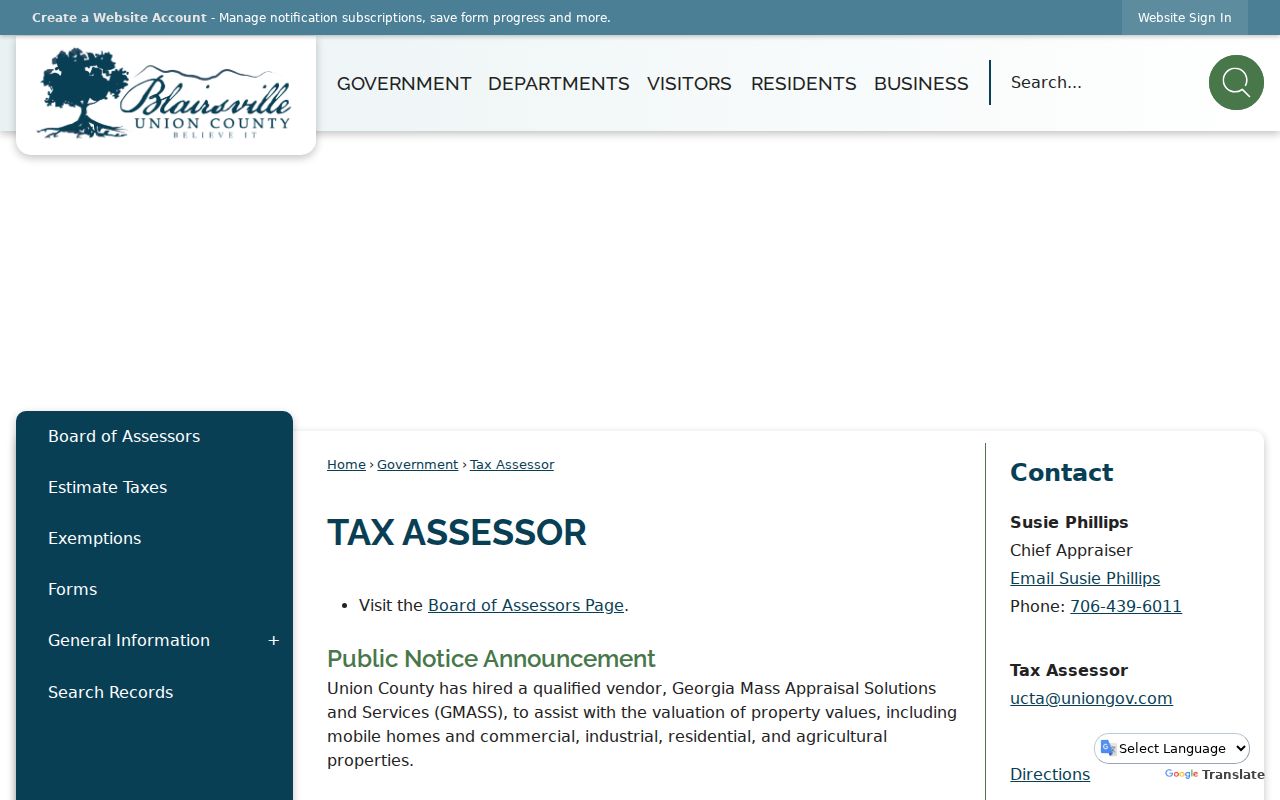
The official Assessor page is the county's entry point for parcel lookups and property record cards.
Confirm Union County Ownership by Deed
A tax-roll name is only an assessment answer. To confirm the latest recorded transfer, search the GSCCCA Real Estate index by grantee. Then compare the instrument against the parcel's legal description. The grantee receives the stated interest. The grantor conveys it. When a name looks recent, search both sides of the transfer. The statewide interface offers grantor and grantee, instrument type, date, and book or page routes. One GSCCCA table shows Union County property-search coverage beginning February 3, 2004. The county's earliest online name-index date is not stated. For older or missing records, visit or call the Clerk at 65 Courthouse Street, Blairsville, 706-439-6022. The recorded-name search screen is the deed-index entry point used for confirmation.
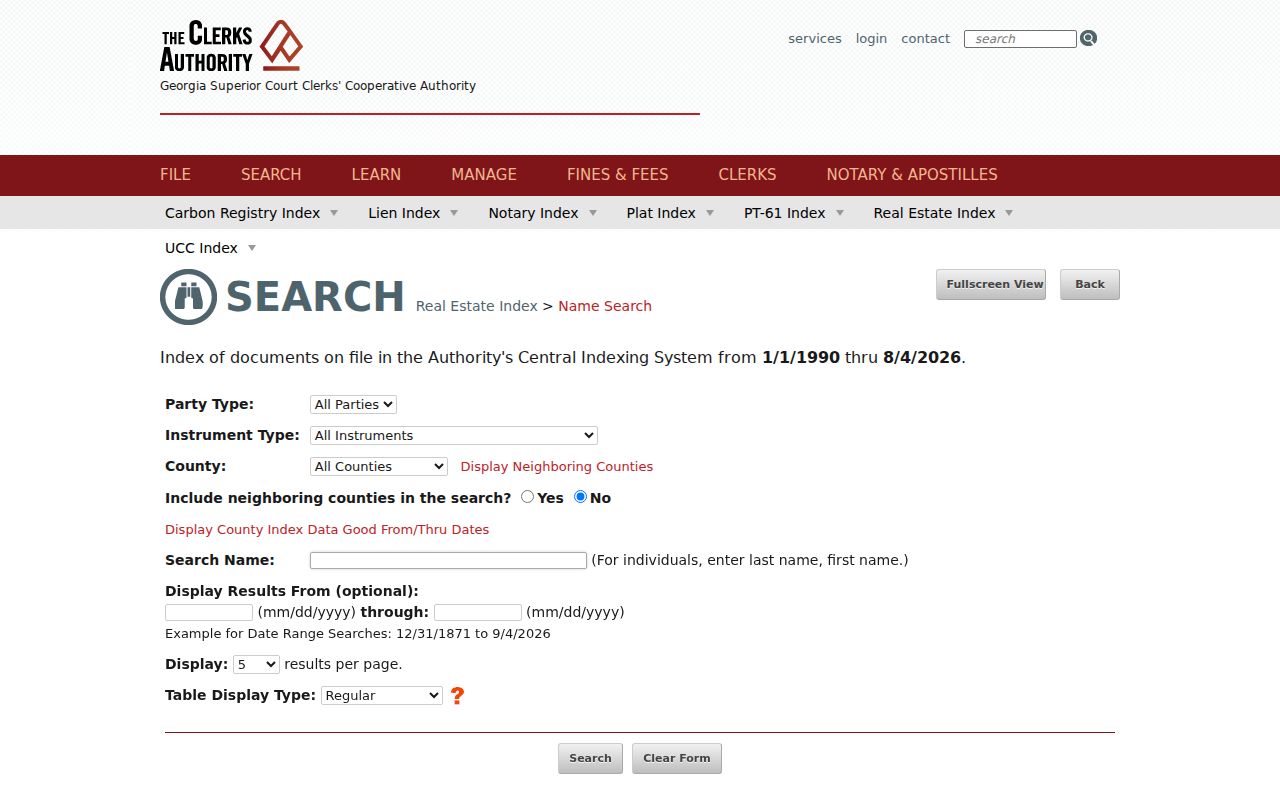
GSCCCA notes that reconstructed index data is informational, and the Clerk's original record controls whenever a mismatch appears.
Union County Addresses Can Differ
A Blairsville 30512 postal address does not place land inside the Blairsville city limits. The ZIP label covers a wider area, and 30514 appears in mailing or post-office-box use. USPS verifies a postal address. County GIS and E911 mapping place the parcel itself. Compare three fields: the situs address, the owner mailing address, and the legal description. The situs locates the taxed parcel. The mailing address receives notices and may sit outside Georgia. The deed description identifies the recorded land. It does so through district, section, land lot, acreage, plat, or metes and bounds. Agreement across those fields beats a name match alone.
- Owner of record
- The person or entity named in the official roll or latest controlling record.
- Grantee
- The party receiving the interest stated in a recorded deed.
- Title
- The legal ownership interest, which a simple public-record lookup does not certify.
- Situs address
- The physical address assigned to the parcel, unlike the owner's mailing address.
Union County Entity Owners
When the assessor names an LLC, search that exact legal name as a GSCCCA grantee. Georgia's Secretary of State business search then adds entity context. It may list a registered agent or officers. Entity records help resolve a name. But they do not transfer title. They are never a substitute for a deed. Trust records may show a trustee or the trust name. Try both forms as they appear on the instrument. An estate can interrupt a simple person-to-person chain. Union County Probate Court keeps records from 2014 forward online. Yet a will or probate order still needs checking against any later recorded deed. The Union County current-owner record card offers the present-tense field check. When a person has died, do not assume the tax-roll name finished the transfer. Do not assume the will alone did either. Search Probate Court for estate administration first. Then search the real-estate index for an executor's deed, administrator's deed, assent, or another recorded instrument. It should be tied to the same legal description. Probate supplies the context. The Clerk's land record remains the confirmation point.
Recent Union County Deeds
Union County values property as of January 1 and describes its parcel information as the most current published digest. It does not publish a normal closing-to-update lag. A recent deed may therefore show a newer grantee than the tax roll. Compare recording date, deed type, legal description, and parcel reference before deciding that one source is wrong.
A security-deed assignment is not the same as a conveyance of the parcel. Georgia uses security deeds for the mortgage trail, so releases and assignments can change the lender-side record without changing the property owner. Focus first on the latest deed that conveys the relevant ownership interest.
Note: A dated digest and a newly recorded deed can differ without either record being a random error.
Watch Future Union Property Filings
Georgia runs a statewide Filing Activity Notification System, known as FANS. A registrant chooses a name or address. The system then alerts them when it matches a new filing involving real estate, liens, plats, or personal property. Union County offers no local alert service of its own. Confirm the owner first. Registering that name gives you a practical way to watch later index activity.
Treat any alert as a prompt, not a verdict. Pull the clerk's recorded image and compare the recording number and the party names yourself. The system cannot stop a filing, and it says nothing about whether title is clean. For added protection, the Georgia Attorney General publishes current title-theft guidance. It includes identity-validation changes that took effect in 2025.
Limits of a Union Owner Lookup
Every lookup has limits. A "who owns this property" result cannot prove who lives at an address. It cannot map out every interest in the land. It cannot surface an unrecorded agreement. It also cannot stand in for a title examination. A trust or LLC may lawfully hold the parcel. Georgia's Safe at Home program can even substitute a protected address in public-facing records. This applies to eligible participants.
Owner information still serves plenty of lawful purposes. Purchase diligence, deed-fraud review, estate work, and boundary or easement questions all fit. Stop when identity turns uncertain. The Clerk can hand you recorded instruments. But a binding ownership opinion belongs to a title professional.
When web tools fall short, use the office chain. Ask the Assessor for a parcel card by situs address, owner name, or map number. Ask GIS to resolve the mapped parcel. Then bring the exact party name, parcel citation, and approximate date to the Clerk counter. Ask there for the deed itself. A focused Georgia Open Records Act request can seek out an existing record that is not indexed. The office need not build a new ownership report for you.
Keep what you gathered. Save the parcel card, the index result, and the deed citation. Dates matter, and a preserved trail makes later changes easier to spot. Before you act on a name, recheck the official sources. A new filing or a digest update can shift the answer. A clear audit trail also keeps two same-name owners from getting confused.
Use records lawfully. An owner name is not a title search. Never use Union County owner information to stalk, harass, threaten, or harm anyone.