
Reconstruct Union County's Deed Chain
Union County publishes no verified first deed book and no complete online starting year, so a former-owner chain simply ends at the oldest instrument you actually read rather than the first result a query returns. Document every name index, book, plat, archive catalog, and newspaper you consult. A missing web hit proves little. It only means that one search came up empty.
For a title decision, a list of previous owners is not enough by itself. Easements, liens, security deeds, releases, probate events, and boundary instruments can all affect the land without ever forming a tidy line of sellers and buyers. The Union County deed records page covers single-instrument retrieval and recorded-copy questions in more detail.
| Transfer date | Grantor to grantee | Deed type | Book/page |
|---|---|---|---|
| Newest first | Current seller to current grantee | Warranty or quitclaim deed | Copy from the instrument |
| Prior step | Earlier owner to current seller | Earlier conveyance | Use the newer deed's source clue |
| Estate step | Estate or representative to successor | Administrator or related deed | Cross-check probate and land records |
| Pre-digital step | Parties in bound indexes | Deed-book entry | Continue at the Clerk counter |
Keep separate rows even when one family or entity appears several times in the deed records. A security deed, assignment, or release protects a lender's interest, and none of them adds a previous owner to the chain. Match each conveyance to the same parcel through its legal description, never through a similar Blairsville mailing line alone. Precision here saves hours later in the property search.
Union County's Online Time Limit
The GSCCCA real-estate name index filters by county. It also covers party role, instrument type, neighboring counties, and date range. It is the main web route for tracing previous owners in Union County property records. Its global start date, though, is not the county's cutoff. The two should never be confused. The service itself labels reconstructed entries as informational. When an entry conflicts with the recorded image or book, the original Clerk record controls. The official GSCCCA search screen shows the name-index filters. A researcher uses these to open a backward deed chain.
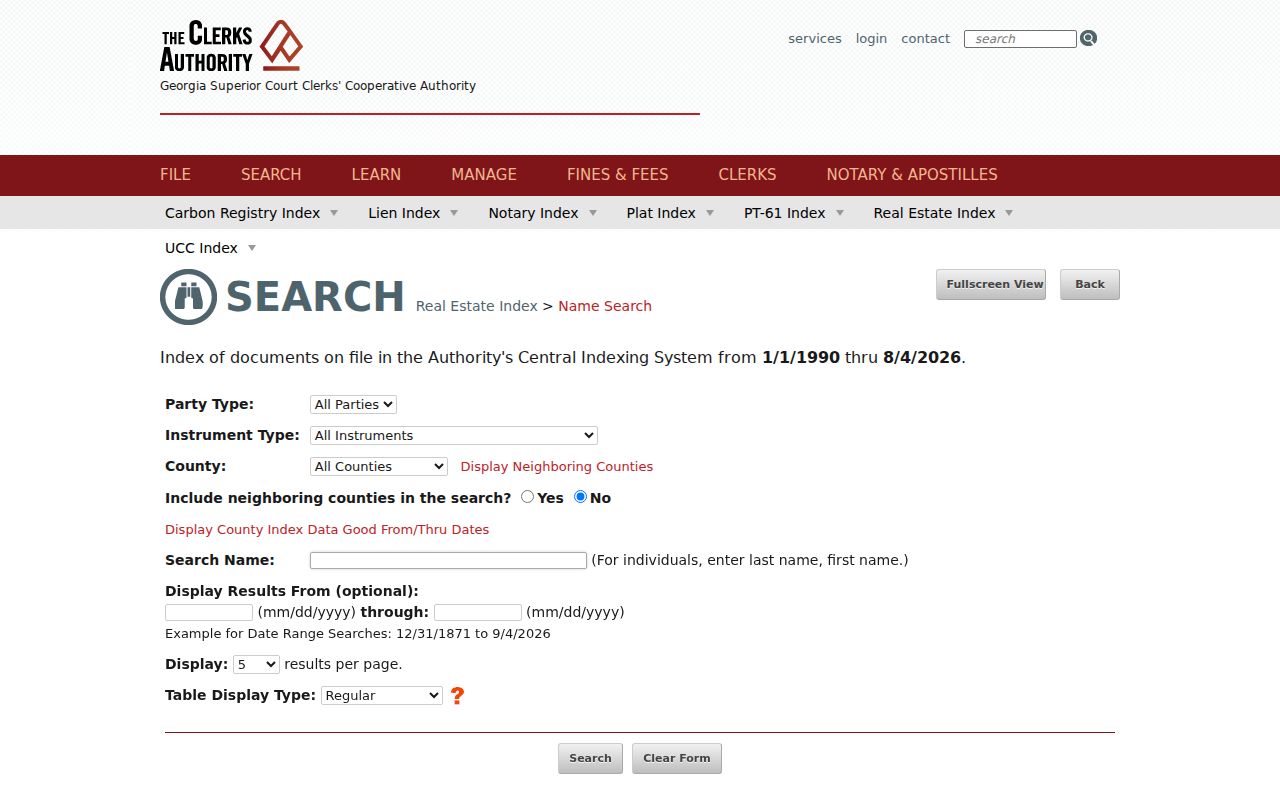
Filters narrow the property search. Every matching row still needs checking against the Clerk's actual recorded instrument. Image and print access can require a GSCCCA account or payment. Preserve the instrument number and book/page citation whenever a result looks incomplete. Then request the original from the Clerk. A missing web result marks the limit of the online deed records. It is not proof that no older deed exists.
Do not assume a cutoff. Union's property-search table begins in 2004, but the earliest online grantor-grantee year remains unverified. Ask the Clerk before declaring a chain complete.
Go Back Through Union Deeds
Read the chain in reverse chronological order. The grantee receives the interest. The grantor conveys it. A chain of title is simply the ordered sequence of conveyances affecting one tract of land. A reverse index groups entries by grantee, which makes it easier to see how a seller acquired the parcel before passing it on. That structure turns scattered deed records into a coherent Union County property search.
- Find the newest conveyance for the parcel and note its current grantee.
- Copy the grantor's full indexed name, deed type, recording date, and book/page.
- Search that grantor as an earlier grantee, trying initials and prior surnames.
- Compare district, section, land lot, acreage, lot number, and plat citation.
- Repeat until the web index stops, then continue in the Clerk's books.
- Grantor
- The party conveying the interest, often the seller.
- Grantee
- The party receiving the interest, often the buyer.
- Chain of title
- The ordered series of instruments linking prior owners.
- Quitclaim deed
- A deed conveying the grantor's interest without the usual warranty-deed promises.
- Reverse index
- An index arranged by grantee name.
Copy Union County Land Citations
Union legal notices show why a common address is the weakest clue of all. Local descriptions layer together district, section, land lot, acreage, lot number, plat book and page, and deed book and page. Easements, covenants, and rights-of-way fill out the rest. Copy the whole citation from each step of the deed chain. That detail separates two owners with similar names. It can also reconnect a tract after an address change.
One 2024 notice tied a survey in Plat Book 40, Page 63 to private-road and utility-easement instruments. County right-of-way instruments appeared as well, spread across three deed books. Not every one of those records marks a change in the owner of record. Together they show how a single land history can span many instruments and indexed names.
Union Plats Preserve Old Names
Historic subdivision names are strong bridges between former owners and modern parcels. Union notices cite James Smith Subdivision at Plat Book Q, Page 115. A 1984 survey and restrictions were recorded in Deed Book 143, Page 112. Pleasant Meadows appears in published plat citations for the county. Kitty Woods and Jewell Mason Overlook appear there too.
Treat those names as finding aids. Then verify each one against the Clerk's plat image. The GSCCCA plat search accepts a name, plat type, county, district or land lot, and date. Union appears among the county choices, though the service publishes no exact local coverage dates. A plat can preserve the lot scheme used by prior owners long after everyday place names shift. That makes deed records and plats natural partners.
Estates Interrupt Union Owner Chains
A death can break the tidy buyer-to-seller pattern. Union County Probate Court handles wills and estate administration. Its records from 2014 onward are described as online. When no ordinary purchase deed explains a later transfer, search the estate, the executor, the administrator, and the individual names in turn. Then go back to the land record itself. A will or probate order may explain who held authority. But the deed filed with the Union County Clerk is what links that event to the parcel. Restricted probate categories stay unavailable. And an online probate hit never replaces the recorded conveyance in the property records.
Older Union County Owner Sources
The digital index eventually runs dry. Head next to the Clerk of Superior Court. The office sits at 65 Courthouse Street in Blairsville. Hours are Monday through Friday, 8:00 a.m. to 5:00 p.m. Bring the last good book and page. Add the party names and an approximate date. Ask for grantor and grantee indexes, deed books, plat books, and any counter terminal with broader access.
Three fallback sources pick up the trail. The Georgia Archives, the FamilySearch catalog, and the Union County Historical Society genealogy library form that tier. The Historical Society keeps local collections and offers Ancestry access, with volunteer help. Georgia Historic Newspapers spans 1891 through 1902. Union County issues there may reveal land sales, sheriff notices, estates, and road disputes.
Many pre-1900 Georgia county records survive on microfilm or through digital partners, though the Archives reading room offers no distance research or copy service. Search the catalog first. Write down the title and film reference. Then plan an onsite visit, or check whether FamilySearch exposes the images. At the Historical Society, ask for deed and tax finding aids, local newspapers, family files, and address-based directories, and treat staff help as a lead rather than promised coverage.
Before Union County Existed
Union County was created in 1832 from portions of Towns and Fannin Counties. A deed chain may continue under those parent names. Georgia land-grant records can also describe a tract before any familiar deed-book chain begins. Do not invent a courthouse fire. Union County has no documented deed-record disaster.
Match the tract first. Confirm its district, section, land lot, acreage, and survey calls before testing an older jurisdiction. County formation is a clue, not proof that a specific predecessor instrument sits in another courthouse. An online search can miss books that still exist.
Test Union County's Earliest Owner
Union County has no confirmed first deed book. Nor is there a fixed year when its earliest land records begin. So a former-owner chain is only as good as its weakest link. Trace it back to the oldest instrument you actually read. Ignore the first name a search happens to return. Keep notes on which deed indexes, plat books, archive catalogs, and newspapers you searched. A missing online hit simply means that one query came up empty.
Previous owners alone will not settle a title question, though. Easements, liens, security deeds, releases, probate events, and boundary instruments can all encumber land. None of it has to appear in a neat line of sellers and buyers. For pulling a single instrument, use the Union County deed records page. It breaks down the retrieval process.
Use the chain lawfully. Former-owner research supports house history, estate work, and property diligence. Never use it to track, harass, threaten, or harm a living person.