
Union County Deed Records by Instrument Type
What a recorder accepts is what the record shows. Union County deed records cover conveyances and also instruments tied to financing, court sales and estate administration. The document type matters. It tells a reader whether a filing transferred an interest or merely affected the land.
| Deed Type | What It Does | Common Use |
|---|---|---|
| Warranty deed | Conveys the stated real-property interest with warranties expressed in the instrument | Ordinary sale or other conveyance |
| Quitclaim deed | Conveys whatever interest the grantor holds without the same warranties | Family transfer or correction |
| Security deed | Secures Georgia real-estate debt and creates a financing trail | Purchase or refinance |
| Foreclosure, sheriff's or tax-sale deed | Records a transfer following the stated sale process | Distressed-property chain |
| Trustee or executor deed | Conveys through a fiduciary acting under authority | Trust or estate transfer |
A security deed, assignment or release belongs to the financing trail. It does not signal a new owner of record. Liens, easements and restrictive covenants can bind the land the same way without conveying it.
The Union County Clerk Is the Official Recorder
The Union County Clerk of Superior Court handles recording. The office records deeds, plats, liens and other real-estate instruments for Union County. Visit at 65 Courthouse Street in Blairsville, Monday through Friday, 8 a.m. to 5 p.m. Its property-record number is 706-439-6022. Deeds need witness and notarization before recording. Plat requirements are stricter. A survey must carry the certified engineer's signature in black ink on the seal, and subdivision plats need County Engineer approval first. Meeting these filing rules does not settle every title question.
Search Union County Deeds Through GSCCCA
The GSCCCA Real Estate Name Search is the online route to deed records indexed by party. Pick Union County, then choose grantor or grantee. Instrument type and recording dates narrow things down. Including neighboring counties helps when a name turns up on land near a county line.
| Search field | Input | How to use it |
|---|---|---|
| County | Union or a wider county set | Choose the recorder jurisdiction |
| Party name | Individual or entity name | Try exact and reasonable name variants |
| Party type | Grantor or grantee | Follow outgoing or incoming transfers |
| Instrument type | Warranty, quitclaim, security deed, lien, easement, covenant and more | Separate conveyances from encumbrances |
| Recording dates | Start and end dates | Target a known ownership period |
| Result view | 5 to 100 rows; regular or one-line | Manage broad name results |
The official GSCCCA real-estate search provides these statewide name-index controls.
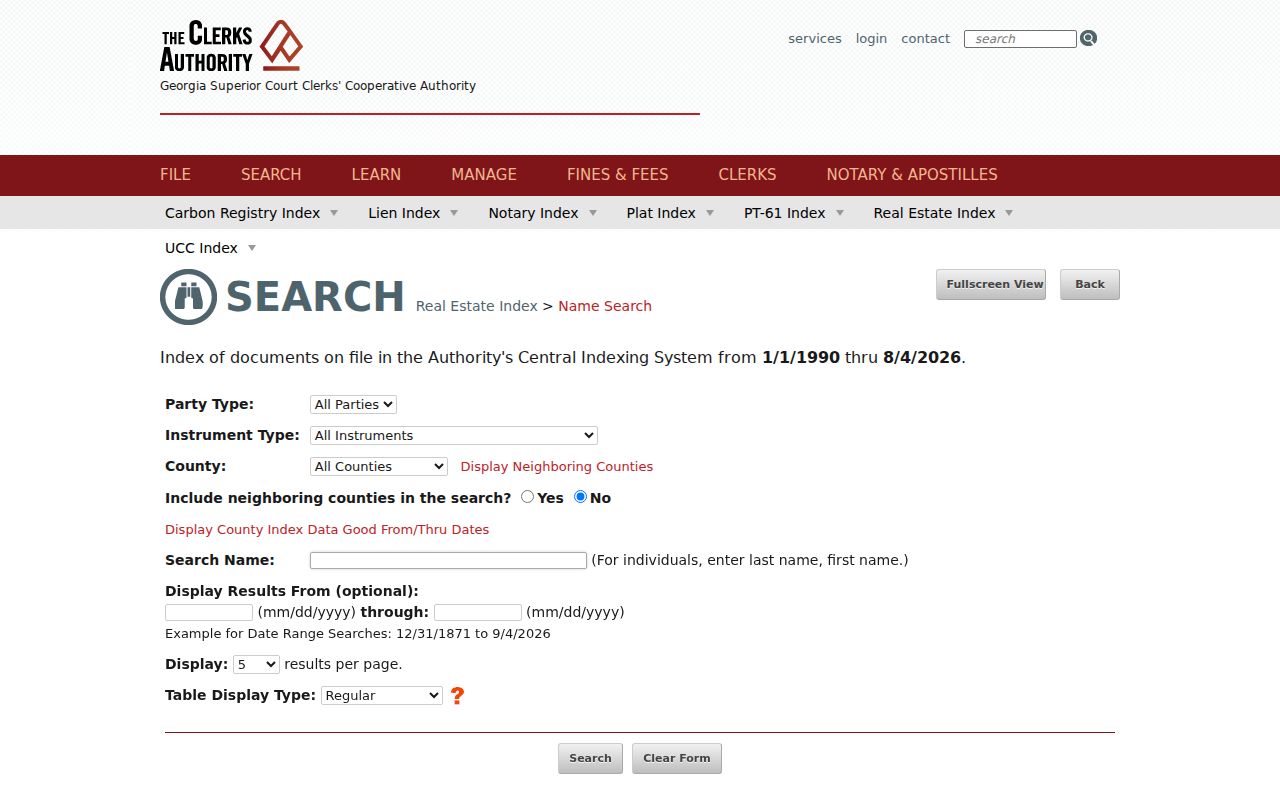
The global interface window that GSCCCA displays is not Union County's local start date for online records. A coverage table lists Union beginning February 3, 2004. Yet Union is not a participating county in that premium subdivision interface. Don't transplant the date to the name index.
Walk the Union County Grantor-Grantee Chain
Start from a deed tied to one parcel. Then work backward, alternating grantor and grantee. A single surname search will pull in results that never touched the land, so keep the recording date, legal description and book/page beside each party name.
- Find the current owner's acquisition instrument with that owner as grantee.
- Read the grantor and full land description from the actual image.
- Search that grantor as an earlier grantee, using dates and instrument filters.
- Repeat while recording each citation and noting any estate, court-sale or name change.
- Move to Clerk books and archival tools when the online trail stops.
- Grantor
- The party transferring the stated property interest.
- Grantee
- The party receiving the stated property interest.
- Chain of title
- The ordered sequence of conveyances connected to the same land.
- Book/page and instrument number
- Record locators used to retrieve the filed image.
Read the Union County Deed Search Result
A GSCCCA result can show the indexed party, the grantor-grantee role, county, instrument type, recording date, book/page or document number, and image status. Two table views exist. Regular and compressed formats are both offered. Viewing the recorded image depends on your account and payment status with the service.
| Party and role | Shows who was indexed and whether that party gave or received the interest. |
|---|---|
| Instrument | Separates a deed from a security deed, assignment, lien, easement or release. |
| Recording date | Dates the clerk filing, which may differ from execution or closing. |
| Book/page or instrument | Provides the citation needed at the Clerk or image service. |
| Image status | Signals availability subject to GSCCCA access rules. |
Search and image services follow separate rules at GSCCCA. The service sells short single-use access, monthly accounts, and per-page print pricing, so confirm current charges before buying.
Security Deeds Create Union County's Mortgage Trail
Georgia leans on the security deed for real-estate financing. That instrument starts the trail. Follow the original through later assignments and any release or satisfaction. Read them in order. Borrower and lender roles do not map neatly onto grantor-grantee language from a sale deed. So keep the instrument type and its stated purpose in view. One 2025 Union foreclosure notice shows the sequence. It cites a 2019 security deed. It also cites a later assignment, a plat reference, and a courthouse-sale process. The notice is only a finding aid. So validate each cited Deed Book and Instrument Number with the Clerk. Note: An assignment may change who holds the secured debt. It does not convey the underlying parcel to a new owner of record.
Union County Legal Descriptions Carry Other Rights
A deed can point past the conveyance itself. One Union County notice for land on Golden Ridge Road tied its plat to a private-road maintenance agreement, utility easements, and a county right-of-way recorded in separate books. Stop at the deed and you miss those instruments. Copy every detail exactly: district, section, land lot, acreage, lot number, plat citation, road agreement, easement and covenant references. Search each cited book/page separately. Compare the burdened or benefited land against the subject parcel.
James Smith Subdivision Links Plat and Deed Books
A local notice identifies James Smith Subdivision through a 1984 survey recorded in Plat Book Q, Page 115. Its restrictions sit in Deed Book 143, Page 112. The pairing makes a useful Union County deed records example. The plat shows the lot pattern. The deed book holds the restrictions. Treat the notice as a lead only. Confirm the subdivision name, lot, survey and restriction text in the Clerk's recorded images before relying on them for a transaction or boundary question.
Use Older Union County Books When Online Results Stop
Union County dates to 1832. The first deed book that survives is not stated anywhere official. One global date appears in the GSCCCA interface. It is not a promise of full Union County coverage. Older deed records stay in books at the Clerk. Reach them through a name index and a book/page citation.
Deeper chains call for other shelves. The Georgia Archives, the FamilySearch catalog and the Union County Historical Society all hold leads. A chain running before 1832 may require predecessor-county names and early Georgia land materials. Do not blame an unexplained gap on fire or flood. No courthouse catastrophe is on record here, so keep searching instead.
Old newspapers earn their keep as well. Georgia Historic Newspapers carries Union County issues from 1891 through 1902. A sale, estate, road or land-dispute notice can hand you a party name, a land lot or a book citation. That citation points back to the official deed record. The clipping is a lead, not proof.
Watch New Union County Filings With FANS
Georgia runs a statewide filing-alert system. The Filing Activity Notification System notifies a registered user when a name or address match appears in real-estate, lien, plat or personal-property filings. Union County has no fraud-alert program of its own.
Register the likely owner-name and address variants. Keep every notice identifier. Then pull the Clerk image and compare it against the alert.
FANS notifies; it does not block recording or guarantee clean title. The Georgia Attorney General publishes guidance on title theft and suspicious solicitations, useful for verification and reporting. Register before a planned deed or plat transaction when you can, using the same name and address variants found in the official records. An alert means one thing: look at the instrument. Until the Clerk image is checked, it proves nothing about validity, fraud or the intended parcel.
Get a Union County Deed Copy From the Right Source
Start with the GSCCCA image route when its account and payment terms fit the job. Some tasks still belong to the Clerk. An original-record check calls for the counter. So does an older book. A certified copy, or a deed missing from the web index, points the same way. Call 706-439-6022 or visit the counter in person. Bring party names and the instrument type. Add an approximate date and any book/page or instrument number already found.
The certified-copy fee is not published in official material. Ask the Clerk for the current price and accepted payment and delivery options. Lacking a citation, offer the property description and a narrow recording window. Georgia Open Records procedures can frame a clear request. Either way, the Clerk remains the custodian for deeds and plats.
Recorded, not guaranteed. Union County deed records show instruments accepted for recording, but an index hit is not a title opinion. Unrecorded interests, defects and record discrepancies may require a qualified title professional.